
By Keith Gangl, CFA®
Bond yields, represented by the 10-year Treasury yield, took center stage in September, pushing the stock market into the background of investor conversations. After a muted August, yields resumed the climb that began in July, rising to 5.29% from 4.44% at the end of June.1
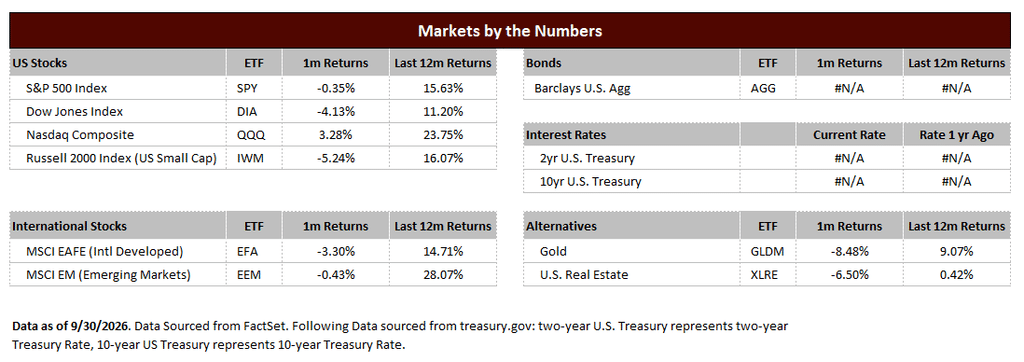
The increase pushed the broad U.S. bond market, represented by the iShares Core U.S. Aggregate Bond ETF (AGG), down 2.62% for the month, one of its worst months since 2022, when the index finished the year down 13.02%.2 The stock market may have lost the spotlight, but its returns still deserve attention: stocks gained 12.75%3 over the first three quarters of the year.
The rise in yields over the past quarter reflects a mix of pressures: persistent inflation concerns, rising yields globally, mounting government deficits, and the Federal Reserve’s decision to raise interest rates on Sept. 16. That move marked a change in course for the Fed, which had been cutting the federal funds rate since September 2024. Its previous hike came in July 2023.4
Rising yields have traditionally been a headwind for stocks, yet the S&P 500 finished the third quarter up 2.30%.5 Oil added another headwind, with West Texas Intermediate crude (WTI) climbing from $69.50 to $89.566 per barrel by quarter-end. A rapid rise in oil prices acts as a tax on consumers and typically leads them to spend less, but that slowdown has not materialized.
For now, investors are looking past higher yields and oil prices to corporate earnings, with S&P 500 earnings growth forecast to exceed 30% in 2026 and another 15% in 20277, well above historical averages.
No one knows when the pressure from higher oil prices and higher yields will ease, but both will shape investment decisions in the coming year. Higher yields raise borrowing costs for governments, companies, and households, and they offer investors a more competitive alternative to stocks. Elevated oil prices, if sustained, could eventually squeeze consumers and erode the earnings growth the market is counting on. The market’s resilience so far is encouraging, but it rests on expectations that leave little room for disappointment.
For investors, the message is to stay disciplined rather than reactive. After three years of strong stock market performance, a period of greater volatility would not be surprising, and it should not be a reason to abandon a well-constructed plan.
Higher yields also bring a silver lining: bonds now offer more income than they have in years, which strengthens the case for a diversified portfolio. Investors who stay the course, keep their allocations aligned with their goals and time horizons and resist the urge to chase headlines will be best positioned for whatever the next quarter brings.
he information provided herein represents the opinions of the author and Gradient Investments, LLC as of the date of publication and is subject to change without notice. This commentary is for informational and educational purposes only and does not constitute personalized investment advice or a recommendation to buy, sell or hold any specific security, including the companies named above. Forward-looking statements, including statements about industry trends, pricing and demand, involve risks and uncertainties, and actual results may differ materially. Investing involves risk, including the possible loss of principal. Data cited from third-party sources is believed to be reliable but has not been independently verified by Gradient Investments, LLC. Indexes provided are common industry benchmarks. Investors cannot invest directly in an index. All investments involve risk, including the possible loss of principal. Index and ETF returns shown are price returns and do not reflect the deduction of fees, expenses, or taxes. Past performance is not indicative of future results.
2 U.S. Aggregate Bond ETF (AGG) Performance
4 U.S. Fed Funds Interest Rate