
By Keith Gangl, CFA®
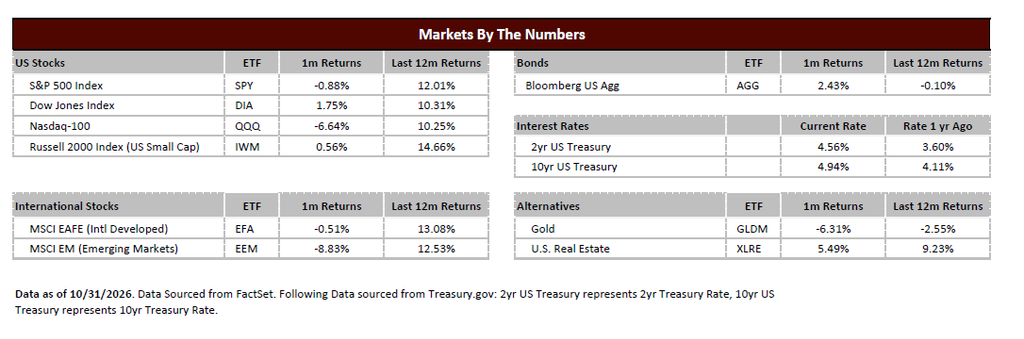
The stock market, as measured by the S&P 500, delivered both tricks and treats for investors in October. Early in the month came the treat: the index hit an all-time high on October 6th, closing above 7,800[1]. The month ended on a spookier note, as a late sell-off left the S&P 500 down 0.90% with the technology heavy NASDAQ stock index down 5.3%[2] for October.
A key driver of the shift from treats to tricks was growing investor skepticism about AI spending by the large technology companies. Alphabet (GOOG), Amazon (AMZN) and Meta Platforms (META) each reported negative free cash flow in their latest quarterly results calling into question the pace of the AI buildout.
The AI buildout has been a tailwind for the market, but these companies can no longer fund it from their own cash flow alone. To finance their capital expenditure plans, they will need to tap the debt market, issue new shares, or both. In October, investors began questioning that spending because the revenue it is meant to generate has yet to show up.
Corporate earnings remain a major force behind the market’s gains. S&P 500 earnings are forecast to grow 32.9% year over year in 2026, and 30.2% in the third quarter[3]. With 60% of companies having reported by the end of October, 82%[4] delivered a positive EPS surprise. Earnings growth has not slowed, but the debate has shifted. Investors once worried that earnings estimates were too low, and now they wonder whether forecasts have become too optimistic.
Even with AI spending in question, investors rotated into other areas of the market, and nine of the eleven S&P 500 sectors finished October higher[5]. Leadership broadened beyond technology, giving investors outside that sector some treats of their own. It is an encouraging sign that investors rotated out of certain stocks rather than out of the market as a whole.
Looking ahead to November, the central question is whether AI investment can prove its worth. Strong earnings and a broadening market provide a solid foundation. But with the largest technology companies now leaning on debt and equity markets to fund their ambitions, investors will want to see clear evidence that the spending is translating into revenue and profit. Until then, expect volatility whenever capex plans outpace the proof of return.
October’s lesson is that a healthy market doesn’t depend on a single story. Technology leadership may be pausing, but a market in which nine of eleven sectors advance can absorb a pullback in its biggest names far better than one that rises on a narrow base. For investors, diversification, patience, and attention to earnings delivery matter more than reacting to any single month’s tricks or treats. If earnings keep delivering and leadership keeps broadening, the market has reason to treat investors well.
The information provided herein represents the opinions of the author and Gradient Investments, LLC as of the date of publication and is subject to change without notice. This commentary is for informational and educational purposes only and does not constitute personalized investment advice or a recommendation to buy, sell or hold any specific security, including the companies named above. Forward-looking statements, including statements about industry trends, pricing and demand, involve risks and uncertainties, and actual results may differ materially. Investing involves risk, including the possible loss of principal. Data cited from third-party sources is believed to be reliable but has not been independently verified by Gradient Investments, LLC. Indexes provided are common industry benchmarks. Investors cannot invest directly in an index. All investments involve risk, including the possible loss of principal. Index and ETF returns shown are price returns and do not reflect the deduction of fees, expenses, or taxes. Past performance is not indicative of future results.