
By Tyler Ellegard
Last week offered a sharp reminder of how concentrated this market has become. A tech-led selloff hit the handful of companies known as the Magnificent Seven hard, in one of the worst stretches for stocks in a while, only for much of that damage to reverse just days later. The speed of both moves tells its own story.
When so few companies carry this much weight in the major indexes, a shift in sentiment toward any one of them, or toward the broader AI theme they represent, can move the entire market more than the underlying fundamentals would suggest.
That kind of swing is worth paying attention to rather than brushing off as noise. It points to two questions that aren’t going away anytime soon: whether the pace of AI spending is still matched by real revenue, and whether portfolios are more exposed to a narrow slice of the market than investors may realize.
Start with the spending side. The largest technology companies have committed hundreds of billions of dollars toward AI infrastructure — data centers, chips and power — on the expectation that demand for AI services will eventually catch up to the cost of building it. That bet hasn’t been disproven, but it hasn’t been fully proven either.
Earnings season has turned into a referendum on this question every quarter, and a single disappointing update, or even a cautious comment about the pace of returns, is now enough to spark the kind of selloff we saw last week. The market isn’t questioning whether AI matters. It’s questioning whether the current pace of investment can be sustained without clearer evidence that it’s paying for itself.
The second thread is just as important. A small group of companies now accounts for an outsized share of major index returns, which means a diversified-looking portfolio can carry far more concentrated risk than it appears to on the surface. That works well when sentiment toward AI is positive, but it cuts the other way just as fast when sentiment turns, as it briefly did last week.
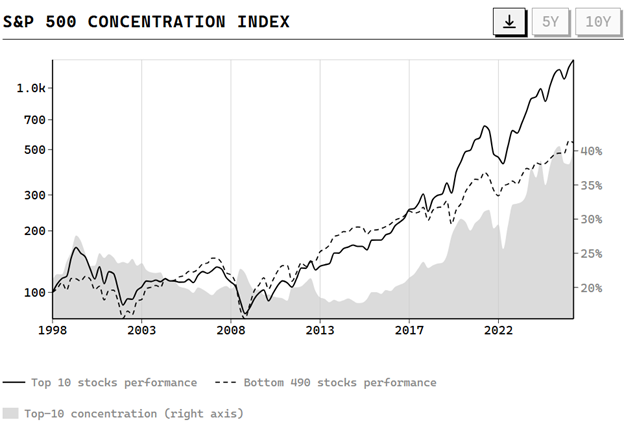
The chart above1 puts today’s gap in context. The solid line tracks the performance of the top 10 stocks in the S&P 500, the dashed line tracks the performance of the remaining 490, and the shaded area shows top-10 concentration over the same period, measured on the right-hand axis.
From the late 1990s through roughly 2017, the two performance lines moved in close step with each other, including through the dot-com bust and the 2008 financial crisis, even as concentration drifted within a fairly narrow band. The two lines began to diverge meaningfully over the past decade, narrowed briefly during the 2022 tech selloff and have since widened to the largest gap on record, with concentration climbing alongside it.
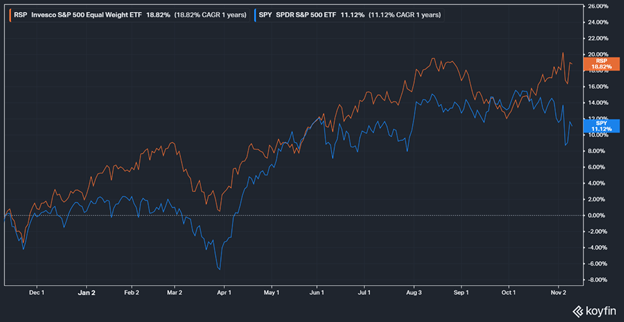
The performance gap between the cap-weighted S&P 500 and its equal-weight counterpart over just the past year makes the point even more directly shown in the graph below.2 The equal-weight version of the index, which gives every constituent roughly the same influence regardless of size, has meaningfully outpaced the traditional cap-weighted index over this stretch.
When equal-weight outperforms by this kind of margin, it’s a signal that strength has broadened beyond the largest names, and that the cap-weighted index’s heavy reliance on a handful of mega-caps can hold it back when those names stumble. It’s a useful reminder that the index most investors benchmark against is not as diversified as its 500 holdings might suggest.
None of this means the AI theme is overextended or that leadership from these companies is undeserved. The underlying businesses remain strong, and the investment case for AI infrastructure isn’t going away.
What last week’s volatility and this divergence between cap-weighted and equal-weight performance suggest is that markets are becoming more sensitive to any sign the AI story is pausing, even briefly. We’ll continue to watch spending commitments, earnings commentary and how broadly gains are being shared across the index as this theme plays out.
1. https://lense-analytics.com/fundamentals/sp500-concentration-index